
It is two months since I joined the Shadow Energy Security and Net Zero team as the Shadow Minister for Clean Power and Consumers. This update shows some of what we’ve been working on so far:
Labour Conference

I participated in a range of interesting discussions with energy and consumer policy experts at Labour conference, setting out Labour’s approach to key issues and discussing new policy ideas.
Some of the panel events I spoke at were titled ‘How do we make energy cheaper?’, ‘How could a Labour government spark a low carbon revolution in our homes?’, and ‘How can the UK lead the world in clean energy?’
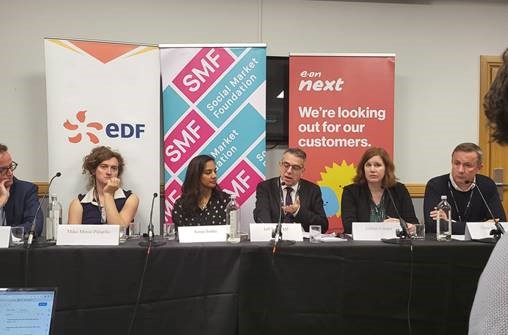
I’m grateful to my fellow panellists, Labour members, and sector experts for such thought-provoking and useful questions and discussion. There is a great deal of consensus on the need to tackle the energy bills crisis, insulate homes, and transition to clean power in a way that benefits the more vulnerable in society and supports good jobs.
Labour’s green policies
Many of Labour’s flagship DESNZ policies have been announced at previous conferences and are set out in our Green Prosperity Plan.
This includes Labour’s mission to make Britain a Clean Energy Super Power, which will:
- Cut energy bills for good, taking up to £1,400 off the annual household bill and £53 billion off energy bills for businesses by 2030;
- Create good jobs, by rebuilding the strength of our industrial heartlands and coastal communities, creating over a million jobs in ten years;
- Deliver energy security, by using our abundant natural resources to free ourselves from the manipulations of Vladimir Putin and petrostates; and
- Provide climate leadership, to protect our planet for future generations.
In government we will:
- Act fast to lead the world with clean and cheap power by 2030, backing the builders not the blockers so Britain gets the cheap, clean power we need;
- Establish GB Energy – a new home-grown, publicly-owned champion in clean energy generation – to build jobs and supply chains here at home;
- Set up the National Wealth Fund, which will create good, well-paying jobs by investing alongside the private sector in gigafactories, clean steel plants, renewable-ready ports, green hydrogen and energy storage; and
- Upgrade nineteen million homes with our Warm Homes Plan, so that families have cheaper energy bills permanently, with warm, future-proofed homes.
Building on this agenda, new policies were announced at Labour conference 2023:
- Labour will establish a new Energy Independence Act
- This will provide the legislative framework for Labour’s landmark energy and climate policies.
- This includes a commitment to put in place the reforms needed to make the UK electricity system fully based on clean power by 2030 with the largest expansion of renewable power in Britain’s history.
- The Act will also establish GB Energy, Labour’s publicly-owned energy company. GB Energy’s first major project will be to invest in thousands of clean energy projects across the country, giving local communities control over investments in their area.
- Labour will rewire Britain, engaging in the largest upgrade to our national clean energy infrastructure in a generation. This will involve:
- Securing the supply chain capacity to build fast. We will use GB Energy to bring the Transmission Operators (TOs) together in a consortium to standardise parts and procure the national grid supply chain the country needs together in a super-tender. That will ensure that Britain is at the front of the global queue for the parts we need, allowing us to get on with building as soon as possible, while cutting costs and passing the savings on to billpayers;
- Bringing jobs and investment to make sure we manufacture the cables we and others need here in Britain
- Providing the incentives we need to build by opening up future grid development to competition, with GB Energy looking to be involved where necessary
Parliamentary activity
Participating in my first Energy Security and Net Zero oral question session as a shadow Minister in the team, I questioned the Minister on findings by the Resolution Foundation which showed that more than a third of British households will face higher bills from October this year because of higher standing charges and the end of Government support schemes. The people who use the least energy, and those in the poorest households, are disproportionately worse off. I urged her to close the loopholes in the current windfall tax, which would raise billions that could be used to extend more help to people with energy bills.
I responded to a Westminster Hall debate on the role of ports in the green energy transition as Labour’s spokesperson, arguing that the Government’s failure to secure offshore and floating offshore wind capacity, or to adequately invest in our ports, was holding back their potential. Labour’s plan is to invest £1.8 billion over five years to ensure that we can construct, manufacture, deploy and maintain offshore wind and marine renewables from UK harbours. This would be the biggest investment in our ports for decades.
I also responded to a Westminster Hall debate on the Contracts for Difference scheme for Labour. As well as highlighting the Government’s inexcusable failure in auction round 5 of the Contracts for Difference scheme, I explained how Labour’s policy of a £500m British jobs bonus would incentivise companies developing clean-power technologies to target their investment particularly at the areas that most need it, investing in UK jobs, skills and supply chains.
 JEFF SMITH MP